
Google E-E-A-T — short for Experience, Expertise, Authoritativeness, and Trustworthiness — is now a major ranking factor in Google’s search algorithm. It helps determine which websites provide reliable, valuable, and credible information to users. For businesses, marketers, and content creators, understanding E-E-A-T SEO is essential to build brand authority, earn user trust, and improve search visibility.
By focusing on real experience, showcasing expertise, and strengthening your website’s authority, you can enhance credibility and attract more organic traffic. Implementing Google E-E-A-T effectively not only boosts your Google rankings but also positions your brand as a trusted source in your industry — leading to long-term SEO and digital marketing success.
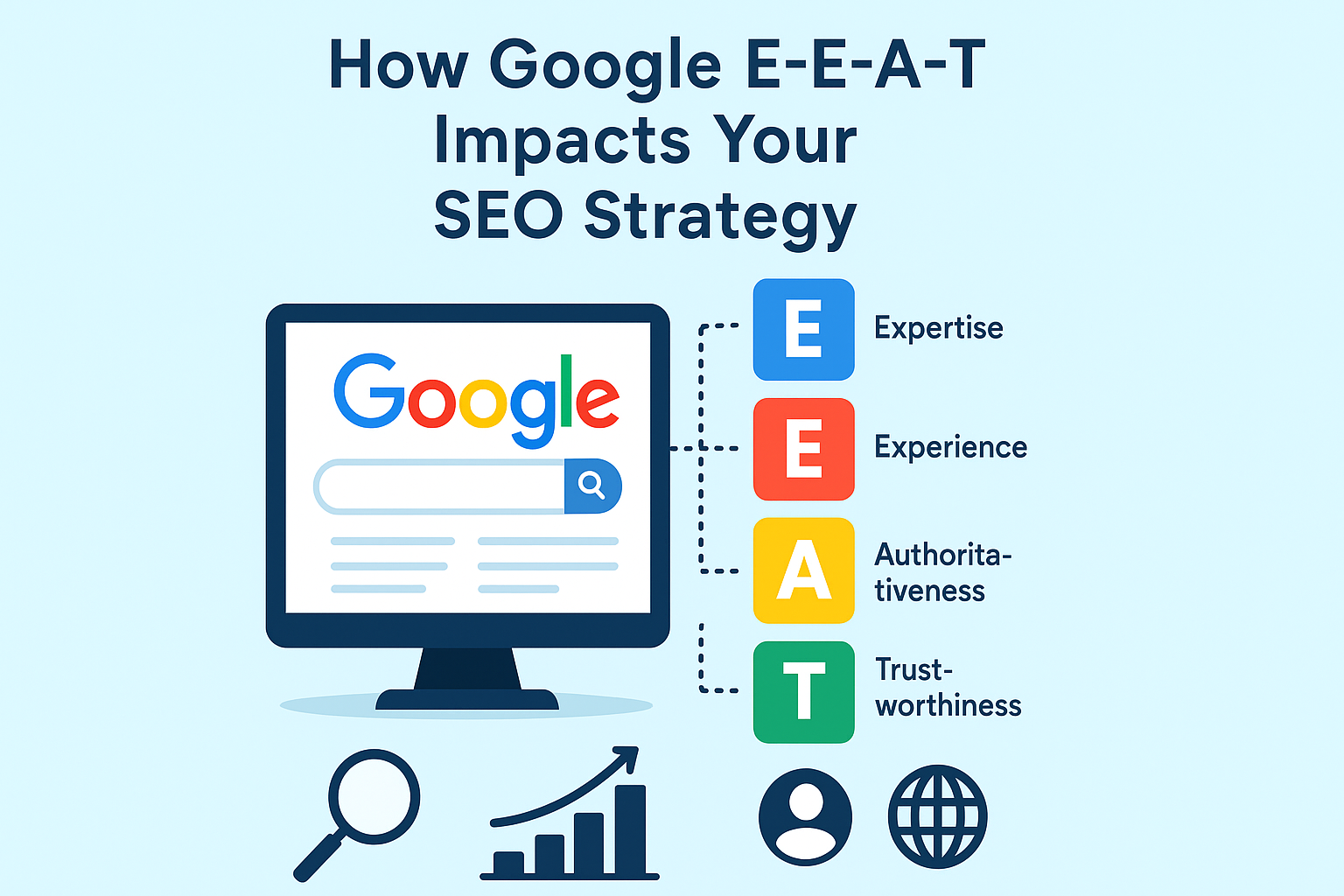
Understanding Google’s E-E-A-T: The Four Pillars of High-Quality Content
Google developed the E-E-A-T framework – to assess the quality and credibility of website content. Each component focuses on a key element that helps determine how your site ranks in search results:
Experience:
Reflects the creator’s firsthand knowledge or real-world involvement in the topic. For example, a health article written by a practicing doctor shows strong experience and builds audience trust.
Expertise:
Measures the depth of knowledge and professional skill in a specific subject area. Authors with recognized credentials or proven expertise in their field tend to rank higher on Google.
Authoritativeness:
Refers to the overall reputation and credibility of the content creator and the website. When your site is cited or referenced by other trusted sources, it signals strong authority.
Trustworthiness:
Evaluates the accuracy, transparency, and reliability of your information. Having a secure (HTTPS) website, clear policies, and factually correct content boosts user confidence and search engine trust.
Websites that score high in all four areas are more likely to rank well, especially for YMYL (Your Money Your Life) content. Examples include healthcare, finance, or legal websites that demonstrate authority and trust through clear authorship, citations, and user reviews.
How E-E-A-T Influences SEO Performance
E-E-A-T SEO plays a crucial role in determining how well a website performs in Google search results. Google prioritizes content that reflects credibility, accuracy, and reliability, rewarding it with higher rankings and better visibility.
For YMYL (Your Money or Your Life) topics — such as health, finance, and legal content — trust signals are especially important. Websites that lack authority or share misleading information risk lower rankings or penalties. On the other hand, strong Google E-E-A-T not only boosts rankings but also improves click-through rates, as users are more likely to engage with content they perceive as trustworthy.
E-E-A-T also strengthens backlink profiles and user engagement metrics. High-quality, authoritative content naturally attracts links from reputable websites, enhancing domain authority and search visibility. Additionally, pages that demonstrate real experience and trustworthiness tend to have lower bounce rates and longer session durations, both of which signal to Google that your site provides genuine value — a key driver of long-term SEO success.
How E-E-A-T Influences SEO Performance
The overall performance of a website and search results are directly impacted by EEAT SEO. Higher rankings may result from Google favoring content that exhibits dependability and credibility.
When it comes to YMYL topics, search engines are especially sensitive to trust signals. Websites that provide false information or lack authority might be penalized or given a lower ranking. Because users feel comfortable interacting with reliable content, high E-E-A-T increases click-through rates.
E-E-A-T affects user engagement and backlink acquisition as well. Credible websites link to authoritative content, increasing its search engine visibility. Lower bounce rates and higher time-on-page metrics—two crucial ranking factors—are typically found on pages that exhibit strong experience and reliability.
Implementing E-E-A-T in Your Digital Strategy
To enhance E-E-A-T signals and match their digital marketing initiatives with Google’s guidelines, companies and marketers can take the following proactive measures:
- Author Biographies and Credentials: Clearly state the credentials of content producers, particularly for niche subjects. This strengthens expertise and increases transparency.
- Citing Reputable Sources: To bolster assertions and information, provide citations and links to reliable websites.
- Frequent Content Updates: To preserve credibility and relevance, keep blogs, guides, and articles current.
- Maintain a professional and unified online presence on your website and other platforms by practicing consistent branding.
Google E-E-A-T implementation improves more general digital marketing initiatives. Credible and well-structured content improves search engine optimization. Social media reinforces brand expertise and helps reach a larger audience by amplifying authoritative content.
Leveraging Google E-E-A-T for Long-Term SEO Success
Online content ranking and trust are influenced by Google’s E-E-A-T framework. Businesses can increase search visibility and user engagement while establishing long-term credibility by emphasizing experience, expertise, authoritativeness, and trustworthiness.
At installs infotech, we assist companies in enhancing their digital marketing by utilizing the potential of EEAT SEO. With more than 100 professionals on staff, we are an award-winning digital marketing firm dedicated to achieving success for Fortune 500 companies as well as small businesses.
We provide quantifiable growth and long-lasting impact by fusing E-E-A-T best practices with local SEO, SEO, and other tactics.
Allow us to assist your company in achieving greater online authority and search engine rankings right now.
Frequently Asked Questions
what is E-E-A-T and how does it work
E-E-A-T stands for:
Experience – Showing you have real, first-hand experience with the topic. (Example: A travel blogger writing about a place they actually visited.)
Expertise – Demonstrating subject knowledge or qualifications. (Example: A certified nutritionist writing about diets.)
Authoritativeness – Being recognized as a reliable source in your field. (Example: Other trusted sites citing or linking to your work.)
Trustworthiness – Being honest, transparent, and secure. (Example: HTTPS websites, clear authorship, no misleading claims.)
How Does E-E-A-T Work?
Quality Raters: Google has human evaluators (search quality raters) who use E-E-A-T to assess whether search results show high-quality and trustworthy content.
Indirect Influence: E-E-A-T itself isn’t a direct ranking factor, but Google’s algorithms are designed to surface content that reflects strong E-E-A-T.
Signals Used by Google:
Experience → User reviews, personal insights, original photos/videos.
Expertise → Credentials, in-depth explanations, accurate information.
Authoritativeness → Backlinks from authoritative sources, mentions in the media.
Trustworthiness → Clear contact info, secure website, factual accuracy.
what are the guidline for Google E-E-A-T in 2025
Here’s a short version of Google’s E-E-A-T guidelines for 2025
Experience: Show first-hand use (case studies, examples, original media).
Expertise: Demonstrate knowledge/credentials with accurate, in-depth info.
Authoritativeness: Earn recognition through mentions, backlinks, citations.
Trustworthiness: Be transparent (authorship, contact info, sources, HTTPS).
YMYL Content: Extra strict — health, finance, legal topics need high credibility.
AI Use: Allowed, but must be human-reviewed and add unique value.
Avoid Spam: No scaled/low-quality, deceptive, or third-party filler content.
User-first: Focus on solving real user needs, not just ranking tricks.
How can I improve E-E-A-T on my website?
Showcase real experience, highlight author expertise, earn backlinks from reputable sources, use clear citations, and maintain site transparency and security.
Does AI-generated content affect E-E-A-T?
AI content is allowed but must be human-reviewed, accurate, and valuable. Google penalizes low-value or purely automated content.