The world of digital advertising is changing in a big way. In the past, pay-per-click (PPC) marketing was mostly done with spreadsheets, manual bidding, and reactive strategies. Now, it is driven by automation, predictive analytics, and smart decision-making. Artificial intelligence (AI) is at the heart of this change.
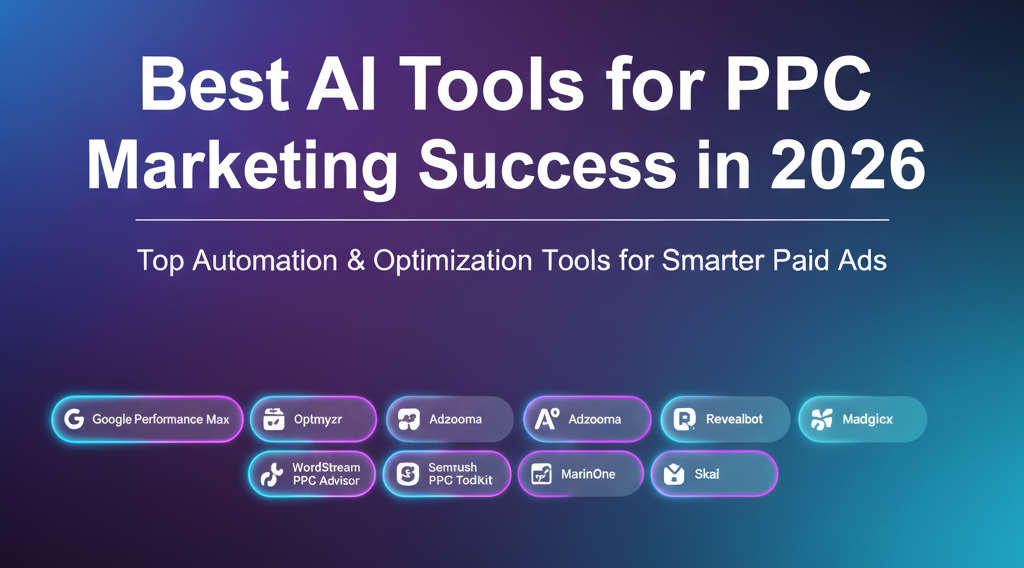
In 2026, running a successful PPC campaign isn’t just about keeping track of keywords and bids. It’s also about knowing what users want, making creative changes on the fly, and combining PPC with other marketing strategies like email and content marketing. Using AI-powered PPC software is no longer an option; it’s a must for both in-house marketers and those who work for digital marketing agencies.
This blog talks about the best AI tools for PPC in 2026, why they are important, and how they fit into the changing role of digital marketing strategies. This guide gives you more than just a list of features. It tells you how to use the platform in the real world, what it can do, and how it fits with Google’s E-E-A-T (Experience, Expertise, Authoritativeness, Trustworthiness) principles. Let’s get started.
The Growth of PPC Ads
PPC has always changed, but the last few years have seen changes that have never happened before. Marketers have had to change since Google introduced Performance Max and stopped using third-party cookies. AI is at the heart of these changes in 2026.
Platforms powered by AI now
Pay-per-click advertising has always evolved, but recent years have transformed it faster than ever before. With innovations like Google Performance Max and the gradual removal of third-party cookies, advertisers have had to rethink how campaigns are built and optimized. By 2025, artificial intelligence will have become the driving force behind modern PPC strategies.
Today’s AI-powered PPC advertising platforms can:
- Automatically adjust bids using real-time conversion and intent signals
- Enhance ad creatives by analyzing user engagement and performance data
- Refine audience targeting dynamically based on browsing behavior and interaction patterns
- Integrate PPC campaigns with content marketing funnels and email automation workflows
As a result, marketers spend less time on manual optimizations and more time on high-impact strategies. The focus has shifted toward persuasive messaging, full-funnel optimization, audience intent, and maximizing long-term customer value rather than just short-term clicks.
What Will Make a Great AI-Powered PPC Tool in 2026?
With countless PPC platforms competing in the digital advertising space, only a few truly stand out. The most effective Pay-Per-Click tools go beyond basic campaign management by combining automation, intelligence, and usability.
Key factors that separate top-performing PPC tools include:
- Advanced Automation: The ability to manage smart bidding, audience targeting, and budget distribution with minimal manual input
- Cross-Platform Integration: Can it align with email marketing and content marketing tools?
- Actionable Insights: Data-driven analytics that provide clear optimization recommendations instead of surface-level reports
- Marketer-Friendly Design: Intuitive dashboards built for marketing teams, not just technical specialists
- Scalable Performance: Flexibility to support startups, growing brands, and enterprise-level advertising campaigns
AI-powered PPC tools that meet these criteria help digital marketing agencies and in-house teams accelerate growth, improve return on ad spend, and manage campaigns more efficiently across channels.
Here are the Best AI Tools for PPC Marketing
1. An Overview of Google Performance Max with Smart Bidding
Google Performance Max uses machine learning and real-time intent signals to run campaigns across Google Search, Display, YouTube, Gmail, and Discover.
Important Features
- Managing campaigns from one place
- Automated optimization of assets and creativity
- Using advanced audience signals
Best for
Advertisers who are very invested in the Google Ads ecosystem want to reach as many people as possible and get the most done.
Pros:
- Deep Google Ads integration
- Real-time conversion prediction
- Minimal setup time
Limitations
- Limited control for advanced advertisers
- Data transparency issues
2. Optmyzr:
Optmyzr was made by people who used to work at Google. It gives advertisers smart automation and lets them control things manually for accuracy.
Main Features:
Automation based on rules
Support for custom scripts and, PPC insight dashboard.d Best For:
Agencies that work with a lot of clients who have complicated needs.
Pros:
- Great for scaling
- A campaign structure that can change
- Very easy to change
Cons:
- Non-technical users have a learning curve
- Too expensive for small budgets
3. Adzooma:-
Adzooma is an AI-driven PPC management platform that uses machine learning to analyze ad performance, provide optimization recommendations, and automate routine tasks across Google Ads, Facebook Ads, and Microsoft Advertising.
Key Features:
- 24/7 campaign performance monitoring
- AI-based recommendations to improve ROI
- Automated optimization tasks to save time
Best For:
Small businesses, freelancers, and solo marketers are looking to simplify PPC management with automation.
Advantages:
- User-friendly dashboard, ideal for beginners
- Fast setup with minimal learning curve
- Helpful AI suggestions for quick optimization
Limitations:
- Limited flexibility for large agencies or complex ad accounts
- Some recommendations may feel generic
Pricing:
Adzooma offers a freemium plan, with paid subscriptions starting at $99 per month.
4. WordStream PPC Advisor: Smart PPC Optimization for SMBs
WordStream PPC Advisor is a well-known AI-powered PPC optimization tool designed to help small and medium-sized businesses manage and improve their paid advertising campaigns through a guided interface.
Core Features:
- AI-generated optimization suggestions
- Integrated landing page performance grader
- Cross-platform insights from Google, Facebook, and Microsoft Ads
Best For:
In-house marketing teams with limited PPC expertise who want structured guidance.
Benefits:
- Weekly performance and optimization reports
- Highly effective for local and regional ad campaigns
- Beginner-friendly with step-by-step recommendations
Drawbacks:
- Lacks automation for large-scale ad accounts
- Limited customization for advanced users
Pricing:
WordStream pricing varies based on business needs and ad spend.
5. Semrush PPC Toolkit
Semrush is best known for its SEO tools, but its PPC Toolkit is also a great way to get competitive information for paid ads. It helps marketers figure out what their competitors are doing, find keywords that will make them money, and improve their ad messages across many channels.
Key Capabilities:
- Competitor ad and keyword tracking
- Keyword gap and opportunity analysis
- Display advertising and PLA insights
Best Suited For:
Content and performance marketing teams that want to combine SEO insights with PPC strategy.
Advantages:
- Deep competitive and market-level data
- Industry-leading keyword research tools
- Supports omnichannel and content-driven strategies
Limitations:
- Does not offer full PPC automation
- Works best alongside execution-focused PPC tools
Pricing:
Plans begin at $129.95 per month
6. Revealbot: Advanced Automation for Paid Social Campaigns
Revealbot is built specifically for paid social advertising automation, enabling teams to manage complex campaigns using custom rules, triggers, and real-time metrics.
Core Features:
- Rule-based automation for ads and budgets
- Bulk ad creation and management
- Custom dashboards with performance alerts
Best For:
Marketing teams and media buyers are running large-scale Facebook and Instagram ad campaigns.
Pros:
- High-level control over ad budgets
- Flexible automation logic
- Designed for professional media buyers
Cons:
- Limited support for Google Ads
- Minimal email marketing integrations
Pricing:
Starts at $99 per month
7. MarinOne: Enterprise-Level AI for Omnichannel PPC
MarinOne is an enterprise-grade PPC platform offering AI-powered optimization across search, social, and eCommerce advertising channels.
Key Features:
- Predictive bidding and forecasting
- Advanced omnichannel attribution models
- Unified budget management across platforms
Best For:
Large digital marketing agencies and enterprise brands are managing high ad spend.
Strengths:
- Highly scalable for global teams
- Built-in forecasting and analytics
- API access for custom reporting solutions
Challenges:
- Complex onboarding process
- Premium pricing is not suited for small teams
Pricing:
Custom enterprise-level pricing
8. Skai (Formerly Kenshoo): Predictive Intelligence for PPC Performance
Skai provides a robust marketing intelligence layer that connects data insights with execution across search, social, and commerce platforms.
Notable Features:
- Real-time campaign analytics
- Unified data from multiple advertising sources
- AI-powered budget and performance recommendations
Best For:
Advertisers focused on predictive planning, forecasting, and omnichannel performance.
Benefits:
- Rich, data-driven dashboards
- Strong omnichannel and commerce integrations
- Advanced decision-support capabilities
Drawbacks:
- Can overwhelm smaller teams
- Steeper learning curve for new users
Pricing:
Custom pricing based on ad spend
9. Madgicx: Creative Intelligence Meets PPC Automation
Madgicx combines AI-driven creative analysis with performance automation, helping marketers optimize visuals, audiences, and budgets in real time.
Key Features:
- AI prediction for creative performance
- Automated audience segmentation
- Smart budget allocation tools
Best For:
Advertisers focused on visual-first platforms like Facebook and Instagram.
Pros:
- Excellent for creative testing and scaling
- Real-time campaign optimization
- Intuitive and beginner-friendly interface
Cons:
- Limited Google Ads functionality
- Primarily optimized for Meta platforms
Pricing:
Starts at $39 per month
How AI Tools Are Transforming Digital Marketing Agencies
AI-powered PPC tools now go beyond automation. For agencies like Installs Infotech, these platforms enable connected, data-driven marketing strategies rather than isolated campaign execution.
Modern AI tools help agencies:
- Connect PPC data with email and content marketing
- Use ad insights to optimize landing pages and blog content
- Deliver hyper-personalized messaging across channels
As agencies scale and manage diverse client portfolios, integration, automation, and intelligence become critical success factors.
AI-Driven PPC in Omnichannel Marketing Strategies
In 2025, PPC advertising is no longer siloed. It plays a central role in a fully integrated omnichannel ecosystem.
Top AI-powered PPC platforms now support:
- Cross-platform targeting (Google, Facebook, LinkedIn, TikTok)
- Unified dashboards for ads and content performance
- CRM integrations for full-funnel lifecycle tracking
This approach results in higher ROI, improved attribution, and better customer experiences.
Choosing the Right PPC Software: Agency vs In-House Teams
Selecting the best PPC tool depends on your structure and goals.
Agencies typically need:
- Multi-account management
- Custom reporting and dashboards
- High scalability and automation
In-house teams often prefer:
- Simple interfaces
- Guided AI insights
- Fast onboarding and minimal setup
Understanding your team’s maturity level and campaign complexity is key to making the right choice.
Common Mistakes to Avoid When Using AI for PPC
Even advanced AI tools can underperform if misused. Avoid these common pitfalls:
1. Poor Data Quality
AI relies on accurate, well-structured data. Inconsistent or incomplete data can lead to flawed insights and suboptimal decisions.
2. Overdependence on Automation
Automation improves efficiency, but human oversight is essential for strategy, creativity, and brand alignment.
3. Misaligned Target Audiences
No AI tool can fix a mismatch between messaging and audience intent. Relevance remains critical.
4. Lack of Creative Testing
Without continuous testing of visuals, headlines, and CTAs, advertisers miss optimization opportunities.
The most successful campaigns balance AI efficiency with human intelligence.
Future of AI in PPC Advertising
Several emerging trends will shape the future of PPC marketing:
- Voice and visual search ads
- AI-generated ad copy and creatives
- Privacy-first targeting solutions
- Automated attribution modeling
- On-device AI for cookie-less tracking
Staying competitive means testing early, adapting quickly, and evolving continuously.
Conclusion
AI has become a foundational element of modern PPC marketing. From automation and predictive insights to omnichannel integration, the Best AI-powered PPC tools of 2025 are redefining digital advertising success.
For businesses and brands aiming to scale paid search, social ads, content marketing, and email campaigns cohesively, working with an experienced digital marketing partner like Installs Infotech can unlock sustained growth and measurable ROI.